
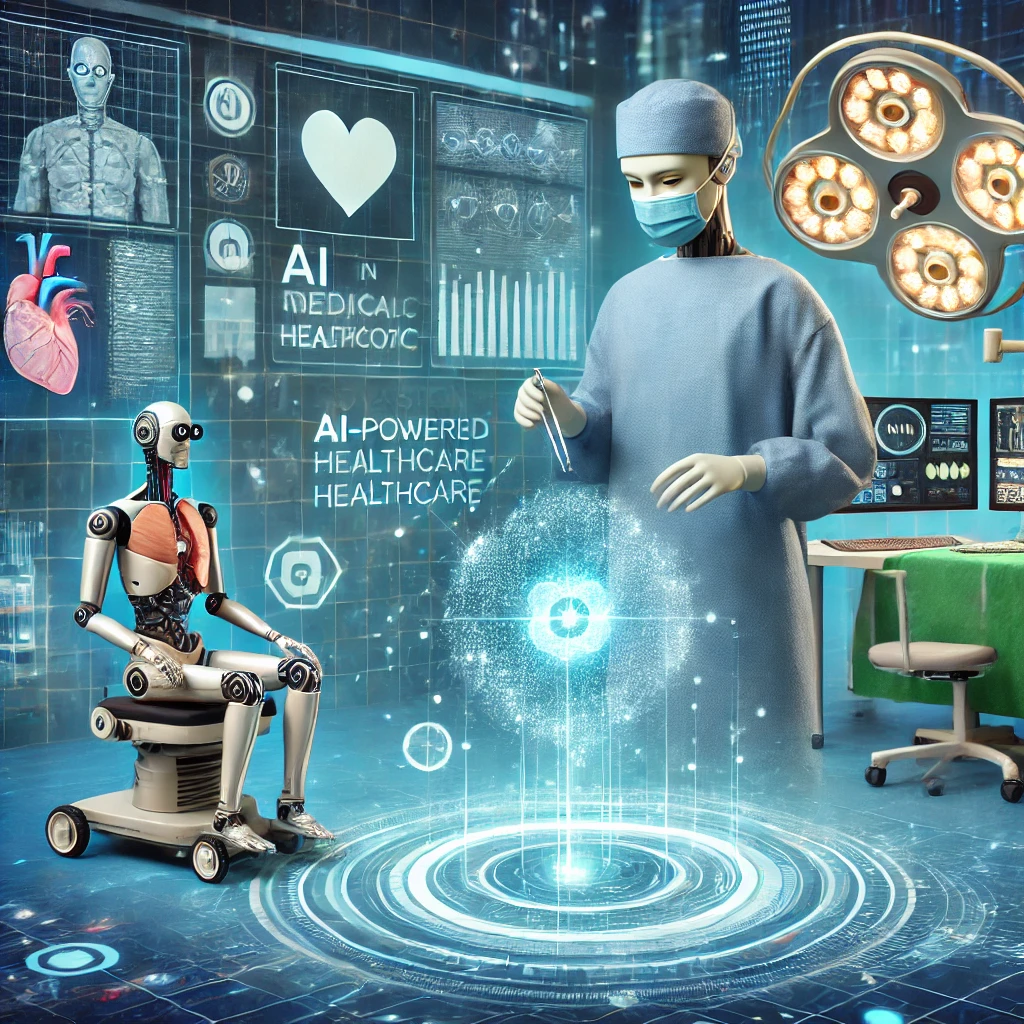
📌 Introduction: AI is Transforming Healthcare
Artificial Intelligence (AI) is revolutionizing healthcare, bringing precision, speed, and efficiency to medical diagnostics and treatment. From AI-powered imaging systems that detect diseases at early stages to robotic surgeries and smart patient monitoring, AI is driving groundbreaking advancements in medicine.
But how exactly is AI helping doctors, patients, and medical researchers? Let’s explore the ways artificial intelligence is shaping the future of healthcare.
1️⃣ AI in Medical Diagnostics: Faster & More Accurate Disease Detection
Diagnosing diseases accurately and quickly is critical for effective treatment. AI is enhancing diagnostic capabilities by analyzing massive medical datasets, detecting hidden patterns, and improving early disease identification.
🔹 How AI is Enhancing Diagnostics
✅ AI-Powered Medical Imaging – AI detects abnormalities in X-rays, MRIs, and CT scans faster than human radiologists.
✅ Predictive Analytics in Pathology – AI examines biopsy samples to predict cancerous growths with high accuracy.
✅ AI-Based Disease Screening – AI models analyze genetic markers, patient history, and symptoms to predict diseases early.
🔍 Example:
- Google’s DeepMind AI accurately detects breast cancer in mammograms, reducing false positives and negatives.
- IBM Watson for Oncology analyzes patient records to recommend personalized cancer treatments.
2️⃣ AI in Personalized Medicine & Drug Discovery
AI is enabling precision medicine, where treatments are tailored to an individual’s genetic makeup, lifestyle, and health history. AI is also accelerating drug discovery by identifying potential compounds and drug interactions faster than traditional research methods.
🔹 How AI is Improving Treatment & Drug Development
✔ AI-Driven Genomic Analysis – AI deciphers DNA sequences to customize treatments based on genetic predisposition.
✔ Smart Drug Discovery – AI predicts how drugs interact with the human body, reducing research time and costs.
✔ AI for Clinical Trials – AI finds suitable candidates for drug trials, improving test accuracy.
🔍 Example:
- BenevolentAI uses machine learning to identify new drug candidates for rare diseases.
- AI-driven drug discovery accelerated the development of COVID-19 vaccines by identifying protein structures quickly.
3️⃣ AI-Powered Robotic Surgeries & Remote Healthcare
Robotic-assisted surgeries are enhancing precision, reducing recovery time, and improving surgical outcomes. AI also enables telemedicine and remote patient monitoring, making healthcare more accessible and efficient.
🔹 How AI is Enhancing Surgery & Remote Healthcare
✔ Robotic Surgery Assistants – AI-powered robots assist surgeons in minimally invasive procedures with extreme accuracy.
✔ AI-Powered Telemedicine – Virtual healthcare systems use AI to diagnose conditions remotely and provide treatment recommendations.
✔ Remote Patient Monitoring – AI wearable devices track vital signs, detect irregularities, and alert doctors in real-time.
🔍 Example:
- The da Vinci Surgical System enables robotic-assisted surgeries, improving precision and reducing recovery time.
- AI-powered chatbots like Ada Health provide instant health assessments and advice based on symptoms.
4️⃣ AI in Predictive Healthcare & Smart Hospital Management
AI helps predict disease outbreaks, optimize hospital operations, and reduce patient wait times. Smart hospitals use AI to manage resources efficiently, ensuring better patient care.
🔹 How AI is Enhancing Healthcare Operations
✔ AI-Based Disease Outbreak Prediction – AI tracks global health data to forecast pandemics and epidemics.
✔ Smart Scheduling & Workflow Automation – AI reduces hospital inefficiencies and patient appointment delays.
✔ AI for Medical Supply Chain Management – AI ensures critical drugs and equipment are available when needed.
🔍 Example:
- BlueDot AI predicted the COVID-19 outbreak before the World Health Organization (WHO) issued an alert.
- AI-driven hospital management systems reduce emergency room wait times by analyzing patient flow patterns.
5️⃣ The Future of AI in Healthcare
AI-powered healthcare is evolving rapidly, bringing new possibilities for medical science and patient care.
🔮 What’s Next for AI in Medicine?
✅ AI-Generated Personalized Treatment Plans – AI will create custom treatment strategies based on real-time patient data.
✅ AI-Driven Mental Health Support – AI-powered chatbots will provide emotional support and mental health assistance.
✅ AI-Powered Nano-Medicine – AI will guide microscopic robots inside the body to target diseases with precision.
✅ AI-Enabled Bioinformatics – AI will accelerate research in genomics and biotech for advanced therapies.
🔍 Example:
- Harvard researchers are developing AI-driven nano-medicine solutions for targeted cancer treatment.
- AI-powered mental health platforms like Woebot provide cognitive behavioral therapy (CBT) through chat-based AI.
🎯 Final Thoughts: AI is the Future of Medicine
AI is reshaping healthcare, making diagnostics more accurate, treatments more personalized, and hospitals more efficient. While AI will never replace doctors, it will serve as a powerful tool to assist medical professionals in saving lives.
💬 What do you think? Will AI-powered medicine lead to faster and better treatments? Let’s discuss in the comments! 🏥
🚀 Take the Quiz: How Much Do You Know About AI in Healthcare?
📌 Test your knowledge on AI’s role in medicine!
[Start Quiz Now]