
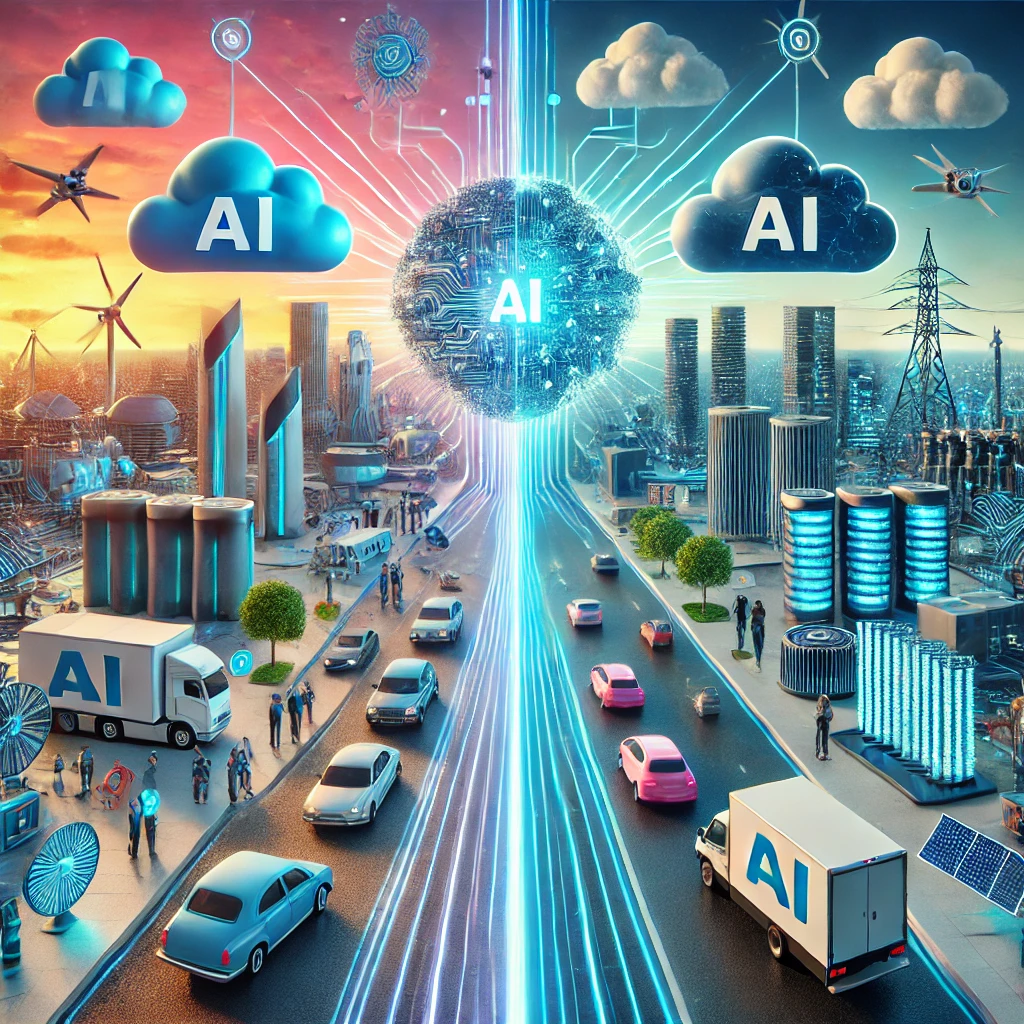
🌍 Introduction: The AI Battle Between Edge and Cloud Computing
As Artificial Intelligence (AI) continues to evolve, two competing technologies are shaping its future—Edge AI and Cloud AI. While Cloud AI processes data in remote data centers with immense computational power, Edge AI operates locally on devices, offering real-time intelligence.
With the rise of 5G networks, IoT devices, and real-time AI applications, industries are debating which approach will dominate in the coming years. Will the centralized power of Cloud AI continue to lead, or will Edge AI’s speed and efficiency revolutionize AI deployment? Let’s explore the key differences, advantages, and future of these two AI paradigms. 🚀
1️⃣ What is Edge AI? Understanding Decentralized AI
Edge AI refers to processing AI algorithms directly on local devices instead of relying on cloud-based servers. This enables real-time decision-making without needing an internet connection.
🛠️ How Edge AI Works:
✔ AI models are embedded in smartphones, IoT devices, autonomous cars, and robots.
✔ AI processing occurs locally on microprocessors (like AI chips and edge GPUs).
✔ Data is processed instantly on the device, reducing latency.
✔ No dependency on cloud servers, making it ideal for applications needing fast responses.
📌 Example: AI-powered self-driving cars rely on Edge AI to process sensor data and make split-second decisions without cloud delays.
2️⃣ What is Cloud AI? Understanding Centralized AI
Cloud AI processes data in large-scale data centers, leveraging massive computational resources for complex AI tasks.
🛠️ How Cloud AI Works:
✔ AI models run on powerful cloud-based GPUs, TPUs, and supercomputers.
✔ Data is collected from multiple devices, sent to the cloud, and processed remotely.
✔ Cloud-based AI systems require stable internet connectivity.
✔ Ideal for big data analytics, AI research, deep learning training, and enterprise AI.
📌 Example: AI-powered virtual assistants like Google Assistant, Siri, and Alexa rely on Cloud AI to process voice commands and return responses.
3️⃣ Edge AI vs. Cloud AI: Key Differences
| Feature | Edge AI | Cloud AI |
|---|---|---|
| Latency | Ultra-fast, real-time processing | Higher latency due to internet dependency |
| Computational Power | Limited by device hardware | High-performance cloud-based processing |
| Internet Requirement | Works offline | Requires an internet connection |
| Data Privacy | Higher security, no data transfer | Data stored in remote servers |
| Scalability | Limited scalability | Highly scalable for big data analytics |
| Energy Consumption | Low-power devices | Requires high-power data centers |
📌 Example: While autonomous drones require Edge AI for real-time navigation, a cloud-based AI model is used for training and refining drone behavior.
4️⃣ Real-World Applications of Edge AI and Cloud AI
🏠 Smart Homes & IoT
- Edge AI: AI-powered smart home devices like thermostats and cameras process commands instantly.
- Cloud AI: Smart assistants use cloud computing to analyze voice commands and search online.
🚗 Automotive & Autonomous Vehicles
- Edge AI: Self-driving cars process sensor data in real-time without cloud dependence.
- Cloud AI: Car manufacturers use cloud AI to analyze traffic patterns and improve autonomous algorithms.
🏭 Industrial Automation & Manufacturing
- Edge AI: AI-powered robotic arms detect and correct defects on the assembly line.
- Cloud AI: Factories use cloud AI for predictive maintenance and large-scale analytics.
📱 Mobile & Wearable Devices
- Edge AI: AI-based face recognition and fingerprint scanning occur directly on smartphones.
- Cloud AI: AI-driven speech recognition and cloud-based AI photo editing.
📌 Example: AI-based medical wearables use Edge AI for real-time monitoring and Cloud AI for long-term health trend analysis.
5️⃣ The Future: Will Edge AI or Cloud AI Dominate?
🔮 Key Predictions for 2025 & Beyond
✅ Hybrid AI Systems: The future will see a mix of Edge AI for real-time tasks and Cloud AI for complex analytics.
✅ Edge AI Expansion: With 5G and advanced AI chips, Edge AI will power more IoT and embedded systems.
✅ Energy-Efficient AI Chips: AI processors will become more compact, reducing Edge AI limitations.
✅ Cloud AI for Research & Enterprise: Cloud AI will continue leading in deep learning, AI training, and big data analytics.
✅ Improved AI Privacy & Security: More industries will shift towards Edge AI to prevent data breaches.
📌 Example: AI-powered real-time language translation will combine Edge AI for fast speech processing and Cloud AI for deep learning improvements.
🎯 Final Thoughts: A Balance Between Edge and Cloud AI
Rather than one replacing the other, Edge AI and Cloud AI will coexist and complement each other. While Edge AI powers real-time, decentralized applications, Cloud AI remains essential for high-performance computing, research, and deep learning.
🚀 Which AI approach do you think will dominate? Will Edge AI take over Cloud AI, or will both thrive together? Let’s discuss in the comments!