
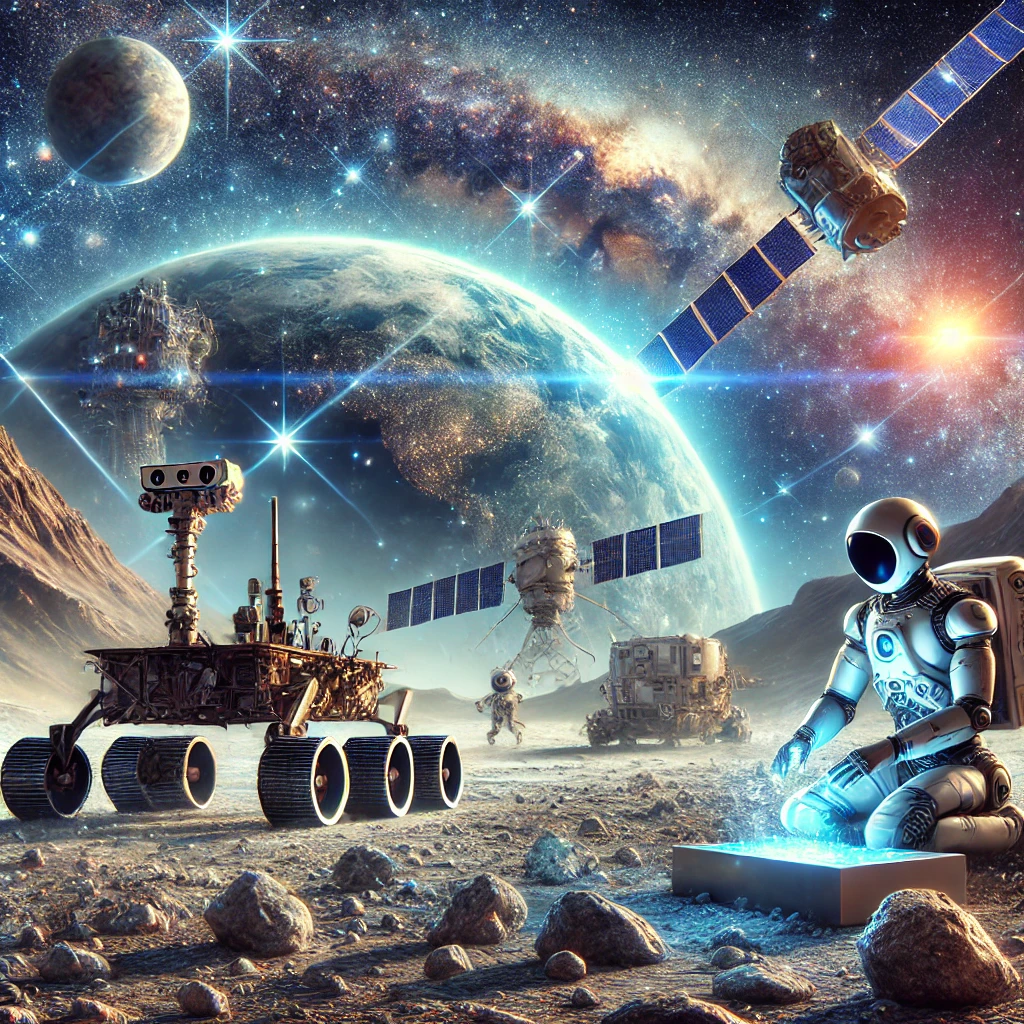
📌 Introduction: AI is Expanding Our Reach into Space
Exploring the final frontier requires advanced technology, and artificial intelligence (AI) is playing a crucial role in space missions. From self-learning Mars rovers to AI-powered telescopes scanning distant galaxies, AI is helping space agencies navigate complex challenges, enhance mission efficiency, and push the boundaries of space exploration.
But how exactly is AI assisting astronauts, analyzing cosmic data, and uncovering new planetary discoveries? Let’s explore AI’s growing role in the future of space missions.
1️⃣ AI-Powered Rovers and Autonomous Spacecraft
Spacecraft and planetary rovers must operate independently due to the long communication delays between Earth and deep space missions. AI enables these robotic explorers to make real-time decisions without human intervention.
🔹 How AI is Assisting Spacecraft & Rovers
✅ Autonomous Navigation – AI allows rovers to explore terrain without waiting for Earth-based commands.
✅ Real-Time Anomaly Detection – AI detects and fixes technical issues before they become critical.
✅ Self-Repairing Systems – Machine learning helps spacecraft diagnose and resolve malfunctions autonomously.
🔍 Example:
- NASA’s Perseverance Rover uses AI to identify interesting rock samples for future human exploration.
- ESA’s AI-powered JUICE spacecraft autonomously adjusts its path while studying Jupiter’s icy moons.
2️⃣ AI in Satellite Technology & Earth Monitoring
Satellites play a vital role in Earth observation, climate monitoring, and space communication. AI is enhancing their capabilities, making them more efficient and responsive.
🔹 How AI Optimizes Satellite Performance
✔ AI-Powered Image Processing – Satellites use AI to analyze climate changes, deforestation, and natural disasters.
✔ Smart Space Debris Tracking – AI helps satellites detect and avoid potential collisions with space junk.
✔ Automated Data Processing – AI enables satellites to process massive datasets quickly and accurately.
🔍 Example:
- NASA’s AI-driven Earth Observing System monitors climate patterns to predict extreme weather events.
- AI-powered SpaceX Starlink satellites autonomously adjust their orbits to avoid collisions with other satellites.
3️⃣ AI in Astronomical Discoveries & Exoplanet Hunting
AI is revolutionizing astronomy by helping scientists analyze vast amounts of cosmic data, identify exoplanets, and detect black holes.
🔹 How AI is Enhancing Space Science
✔ AI-Driven Telescopes – AI enhances the performance of space telescopes by identifying celestial objects faster.
✔ Deep Learning for Exoplanet Detection – AI analyzes telescope images to find Earth-like planets.
✔ AI in Black Hole Research – Machine learning helps scientists understand the behavior of black holes.
🔍 Example:
- NASA’s Kepler mission used AI to discover exoplanets in distant star systems.
- AI-powered Event Horizon Telescope (EHT) helped capture the first-ever image of a black hole.
4️⃣ AI and Robotics in Space Stations
AI-driven robotic assistants are supporting astronauts by performing tasks, monitoring life-support systems, and ensuring mission safety.
🔹 AI-Powered Robots in Space
✔ Smart AI Assistants for Astronauts – AI-driven robots help astronauts with experiments, maintenance, and safety checks.
✔ AI-Integrated Life Support Systems – AI monitors and optimizes oxygen, temperature, and radiation levels.
✔ Automated Space Repairs – AI-driven drones repair and maintain space station components.
🔍 Example:
- CIMON (Crew Interactive Mobile Companion) is an AI assistant aboard the ISS that helps astronauts with scientific tasks.
- Robonaut 2, developed by NASA, assists astronauts in high-risk environments aboard the ISS.
5️⃣ The Future of AI in Space Exploration
AI will play a greater role in future interplanetary missions, space colonization, and deep-space exploration.
🔮 What’s Next for AI in Space?
✅ AI-Powered Space Mining – AI will help identify and extract resources from asteroids.
✅ AI-Driven Terraforming Research – AI will model the atmosphere and climate of Mars for future colonization.
✅ AI for Deep Space Navigation – AI will assist in autonomously piloting spacecraft beyond our solar system.
✅ AI in Alien Life Detection – AI will analyze space signals to detect extraterrestrial life.
🔍 Example:
- NASA’s Artemis program is exploring AI-driven missions for sustainable human presence on the Moon and Mars.
🎯 Final Thoughts: AI is Pushing the Boundaries of Space Exploration
AI is redefining how we explore space, making missions more autonomous, efficient, and data-driven. While AI is a powerful tool, human expertise remains essential in making final mission decisions.
💬 What do you think? Will AI help us reach Mars faster? Could AI find signs of alien life? Let’s discuss in the comments! 🌌
🚀 Take the Quiz: How Much Do You Know About AI in Space?
📌 Test your knowledge on AI’s role in space exploration!
[Start Quiz Now]